Biodiversity
Research
in the Great Smoky
Mountains National Park
(ALL
LINKS WILL OPEN IN NEW BROWSER WINDOW. TO RETURN TO THIS PAGE, JUST
CLOSE YOUR BROWSER WINDOW.)
|
What
would it be like to be part of a scientific research team funded by the
National Science Foundation? What would it feel like to do some of your
work suspended in a tree 80 feet above the ground in a forest of the Appalachian
Mountains?
Are you
fascinated with nature and wildlife? Are you concerned about the fate of
the world around you? Consider yourself a 20 year old college student and
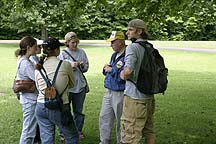
join Cheryl, Erin, Tommy, Amber, and Ashley as they become involved in
Dr. Harold W. Keller’s passion for the beauty and diversity
of the Great Smoky
Mountains National Park (GSMNP). |
 |
 |
Hi,
I'm Amber!
|
|
I'm
Ashley!
|
 |
 |
I'm
Cheryl!
|
|
I'm
Erin!
|
 |

|
I'm
Tommy!
|

Dr.
Harold W. Keller is well known for his research on myxomycetes
(slime molds!), life forms he calls "the biological jewels of nature".
Dr. Keller has stated in his own words, “I fell in love with the Great
Smoky Mountains right after I fell in love with my wife!” His passion
for the GSMNP is equaled
by his commitment to involving undergraduates and graduate students in
scientific
research (click on link to learn more). This commitment has resulted
in numerous grants that have funded research providing great adventures
for students like you!
Most
things in life have a price tag attached and scientific research is no
exception. Most scientists either work for large corporations who profit
from the scientist’s results or they teach in universities and write grants
to get extra funding to support their research. The research that you are
going to experience in the following pages has been funded with approximately
$190,000 by the National Science
Foundation (NSF), the National
Geographic Society, and Discover
Life in America through multiple grants written between 2000 and
2005. It takes a great deal of money to cover the expenses of taking
a large team of researchers to a field site and scientists must be very
good at writing clearly and budgeting carefully to convince organizations
to fund their grant proposals!
This
research project is named RUI: Biodiversity and Ecology of Tree Canopy
Biota in the Great Smoky Mountains National Park and it’s purpose
is to complete the first comprehensive survey and inventory of tree
canopy biodiversity for
cryptogams,
selected insect groups, and molluscs in the Great Smoky Mountains National
Park. The objectives to be achieved with this biodiversity survey will
be to:
|
•assemble
a multidisciplinary research team of experts who will collect, identify,
and curate this diverse group
of organisms and serve as mentors who will give special lectures, slide
shows, hands on identification of specimens, and field demonstrations to
aid undergraduate students in the recognition of specimens and collection
of bark samples
• compare
the assemblages (groups) of tree canopy organisms with those found on ground
sites
• search
for species new to science in all of the targeted groups of organisms
• sample
for cryptogams along vertical transects
of individual trees at different heights to quantify the association of
the relative species composition, abundance, and diversity of these assemblages
with the available environmental characteristics (host tree species, vegetation
type, height class, light, pH, and humidity)
• compare
the tree canopy-targeted groups on different tree species
• provide
research experiences for students that will enhance opportunities for postgraduate
study |